I haven’t had one linear identity.
I’ve had chapters.
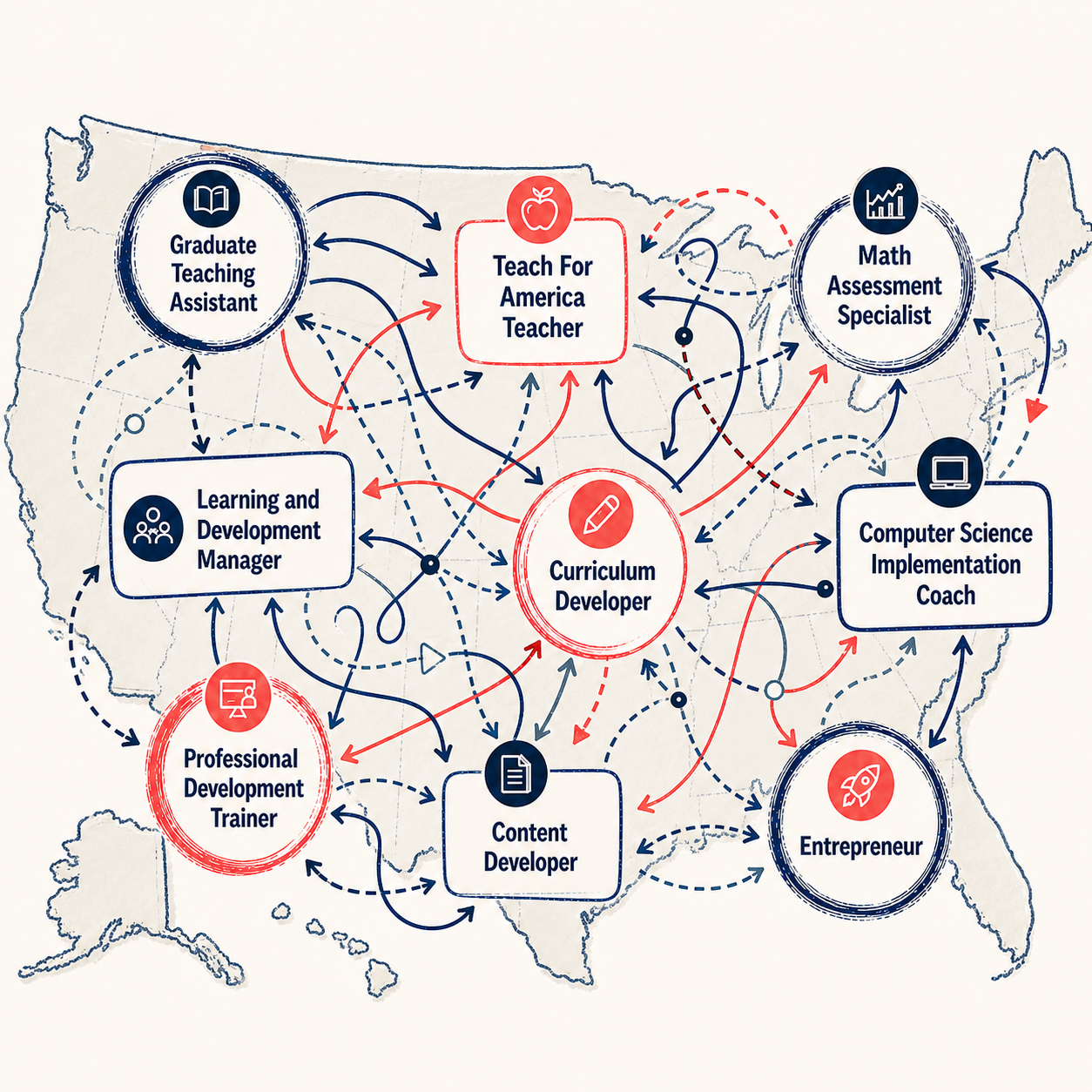
I went from graduate teaching assistant, to Teach For America teacher, to math assessment specialist, to computer science implementation coach, to curriculum editor, to curriculum developer, to learning and development manager, to professional development trainer, to content developer, to entrepreneur.
I’ve also moved 20 times.
I’ve supported a family.
I’ve made choices that only made sense because of real life.
Here's a rough sketch of what my professional journey has looked like:
Here's the bottom line...
Careers are built while people are paying rent, raising kids, moving cities, caring for family, recovering from burnout, trying to earn more, and making the best choice with the facts they have.
So as an educator trying to leave the classroom, hear this clearly:
You. Are. Building. A. Life.
Sometimes building a life means taking the job that pays more.
OR it means taking the job that gives you breathing room.
OR it means stepping sideways before you step forward.
OR it means choosing stability over status.
None of these choices are wrong.
It means you’re a person with real bills, real needs, and real people depending on you.
Why This Matters to You
When I was first transitioning, I assumed I’d move pretty naturally into an L&D role or a curriculum role.
That made sense to me.
I had teaching experience.
I had curriculum experience.
I had experience helping people learn, practice, understand, and improve.
But when those roles didn’t happen right away, my thinking started to change.
I started considering roles that were much farther away from the professional life I was trying to build.
I widened the net to include the possibility of retail, grocery, hardware, local businesses I hadn't heard of until then...
Not because those jobs were bad. Not at all.
But because I was scared.
I worried about money.
Then, I worried about losing the professional identity I’d worked hard to build.
Then, I worried that one practical choice would make it harder for employers to see me as someone who belonged in education-adjacent work, learning roles, training roles, curriculum roles, or leadership roles.
That’s the real fear for a lot of transitioning teachers.
It’s not just, “Can I get a job to pay my bills?”
It’s:
“What happens to who I think I am when the job I can get doesn’t match the identity I’ve built?”
That fear can make every option feel incredibly heavy. The tradeoffs start to feel overwhelming.
But make no mistake. Fear is an asshole.
Sorry for the language but I'm pretty charged up about this.
Fear lies to you about who you are, what people will think, and it'll try to tell you your whole future when it doesn't know a damn thing.
Common Solutions and Why They Might Not Work
COMMON SOLUTION 1:
When fear takes over, a lot of people start applying everywhere.
Anything remote.
Anything that pays enough.
Anything that sounds easier than teaching.
Anything that gets them out.
I understand why that happens.
But that kind of search creates more work for you and that's definitely NOT what I'd recommend.
You end up with too many directions, too many resume versions, and no clear story about what you actually want next.
COMMON SOLUTION 2:
Another common thing to do is to only chase the title that sounds the most like the dream.
Instructional designer.
L&D specialist.
Curriculum manager.
Program manager.
Education consultant.
Those may be great options.
But they may not be the only options.
By choosing the middle ground between these two options, the goal becomes making your next move from a place of calm and real-world data.
I have both of those in spades for you.
A Better Approach for You
You don’t need to make your career change look glamorous.
You need to make it work for YOU.
Start by asking:
"Does this role help me protect my direction?"
That means your next role might be at a place that doesn’t look “education-adjacent” at first.
A hospital needs training.
A software company needs customer education.
A nonprofit needs program support.
A corporate team needs onboarding materials.
A small business needs systems, communication, and content.
A government agency needs people who can implement a system quickly.
Those places may not fit exactly what you've imagined so far BUT the work still uses your strengths.
So instead of asking, “Does this place look like where I thought I’d end up?”
Ask:
“Does this role let me use skills I want to keep using?”
That’s the better filter.
That's how you protect your direction.
TL;DR:
- A non-linear career doesn’t mean your career is broken.
- Career change brings up real fears about money, identity, purpose, and stability.
- Your next job doesn’t have to be at an education company to make sense.
- A practical choice can still be a thoughtful choice.
- The goal is to make decisions from strategy and direction, not fear.
Your Next Steps
This week, look at the roles you’ve been considering and sort them into three groups:
Aligned roles: These use skills you want to keep using and move you toward the work you want.
Bridge roles: These may not be the final goal, but they give you income, stability, space, or experience you can use.
Fear roles: These are roles you’re considering mainly because you’re scared or desperate.
Then ask: “What would this role help me protect?”
Your income?
Your health?
Your family?
Your confidence?
Your direction?
Your future options?
Circle the ones that actually help with at least two pieces of the list above.
Then remove or pause the roles that don’t help.
This one step will help your nervous system chill out long enough to know what's worth focusing on and what is simply fear being a jerk to you.
P.s.
My Career Change Accelerator™ can help you move from scattered job searching to a more strategic position. You don’t have to make your career change from fear. Let's make it with clear steps. Plug into my brain and follow the steps I've put together: 1, 2, then 3. I've got your back.
Hope this clears out some of the fear and fog from your brilliant brain.
See you next week.

Steph Yesil
Find me on LinkedIn, Get My Career Change Kit,
Book a 60-Min Strategy Call